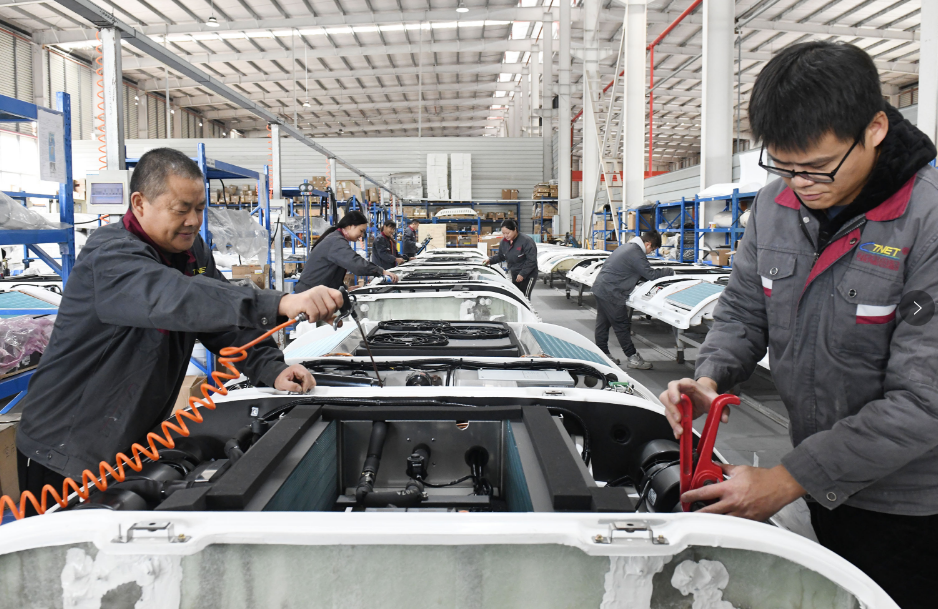
Bus interurbains bus air conditioner adjust and control the temperature, humidity, air cleanliness, and air flow within bus compartments to optimal levels.
This ventilation system provides passengers with a comfortable riding environment and reduces travel fatigue.
It creates favorable working conditions for drivers and plays a vital role in ensuring safe driving.
It typically consists of a condenser, a fluid storage tank, a compressor, high- and low-pressure piping, an evaporator, and an expansion valve.
Algeria interurbains buses are designed to connect cities and towns over longer distances. They are part of the public transport system that serves urban and interurban areas.
Algeria bus air conditioners can be sourced from bus air conditioner suppliers and manufacturers in China, according to engineers at the Algeria Bus Group. Algeria Bus Group is contacting busclima@kingclima.com for bus air conditioner suppliers in China to obtain the best service and solutions. Algeria Interurbains Bus Key Features
Long-distance Service
Interurbain buses connect cities and towns, covering routes that are longer than urban bus lines.
Part of the Public Transport System
They are operated by public transport companies such as RATP (Régie Autonome des Transports Parisiens) in France, which manages urban and interurban transport networks.
Modernization and Improvement
Recent years have seen improvements in interurbain transport systems, including the modernization of buses and routes.
Related Terms
Interurban (adjective) - referring to transportation between two or more cities.
How Algeria Bus Air Conditioner Work
According to a natural phenomenon, when any substance is cooled, it releases heat.
To achieve this, a compression-type refrigeration unit is used on buses. Refrigerant circulates in closed pipes, constantly switching back and forth between liquid and gas phases. The principle is to compress the gas; condense it by releasing heat; and then, by absorbing heat, reduce the pressure, causing the liquid to vaporize.
The compressor extracts cool, low-pressure gaseous refrigerant.
The refrigerant is compressed within the compressor, raising its temperature.
This refrigerant is then forced into the circulation pipes (on the high-pressure side, where it is in gaseous form and at high temperature and pressure).
The refrigerant travels a short distance to the condenser (liquefier).
The compressed and heated gas in the condenser removes heat from the passing air (wind and fan air).
When the dew point, determined by pressure, is reached, the refrigerant gas begins to condense, turning into a liquid (at this stage, the refrigerant is in liquid form, at high pressure and at moderate temperature).
The compressed liquid refrigerant continues to flow to a constriction, which may be a throttle valve or an expansion valve. Here, the refrigerant is injected into the evaporator, causing its pressure to drop (low-pressure side).
In the evaporator, the injected liquid refrigerant is depressurized and evaporates (gasifies).
The heat of vaporization required for this is removed from the warm fresh air flowing through the evaporator fins, thereby lowering the air temperature and cooling the vehicle interior (at this stage, the refrigerant is in a vapor state with low pressure and temperature).
The refrigerant, now in a gaseous state, flows out of the evaporator. It is extracted again by the compressor and recirculated through the circuit (at this stage, the refrigerant is in a gaseous state with low pressure and temperature).
Bus interurbains Bus Air Conditioner - Air Conditioning Compressor
Swash plate axial piston compressors are currently the most commonly used compressors.
The rotational motion of the drive shaft is converted into axial motion (equal to the piston lift) by a swash plate.
Depending on the design, three to ten pistons may be used, arranged around the drive shaft, each equipped with a suction/pressure valve.
The rotational motion of the drive shaft is transmitted to the drive hub and converted into axial motion of the pistons via the swash plate. The swash plate slides longitudinally within the guide rails. The swash plate's tilt is variable, allowing the piston stroke and, consequently, the output power (cooling capacity) to be varied.