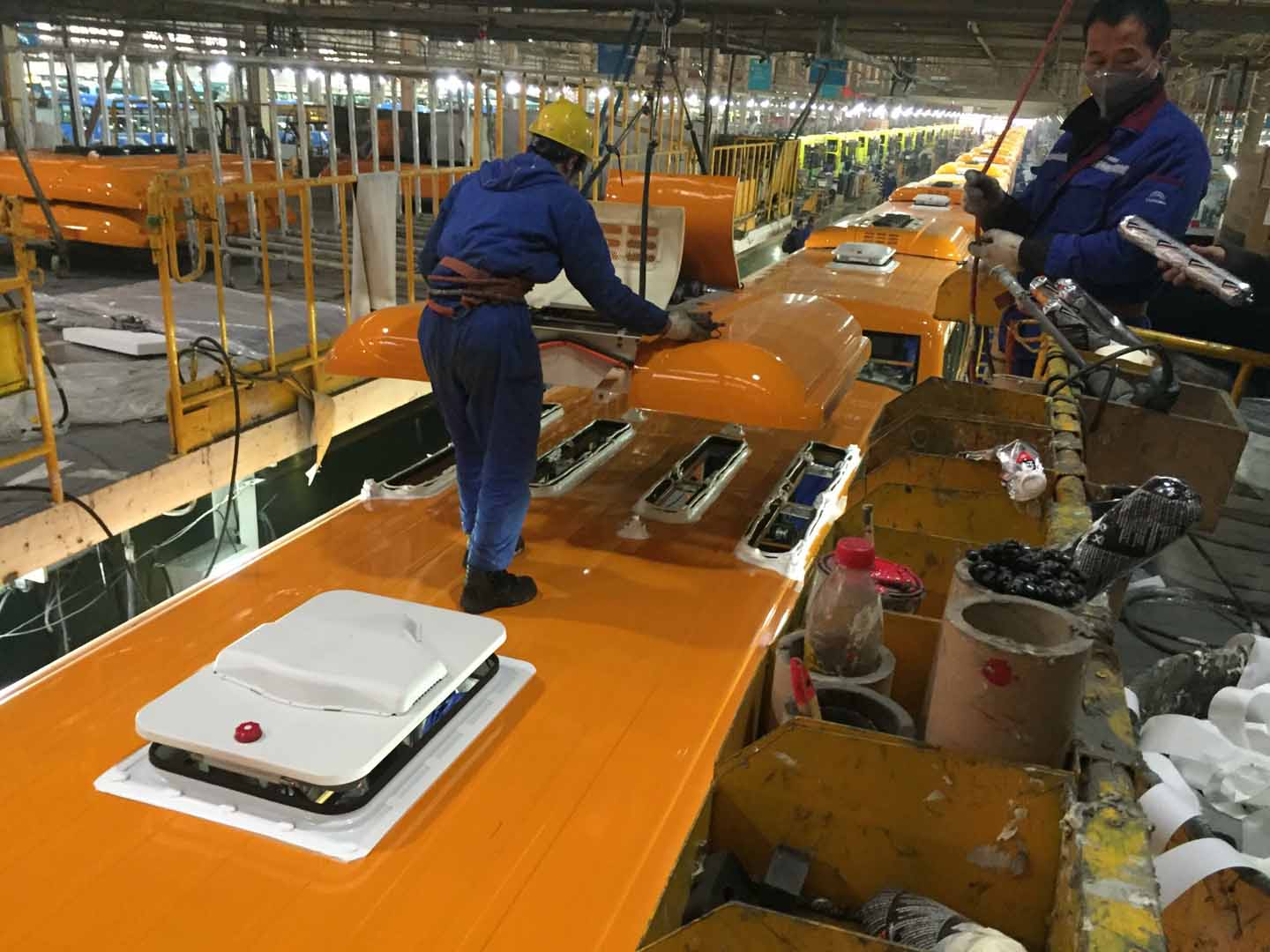
Maghreb Bus Air Conditioner consists of a compressor, condenser, receiver-dryer, expansion valve, evaporator, and blower.
These are connected by copper pipes and high-pressure rubber hoses to form a closed system.
When the refrigeration system is operating, the refrigerant circulates in different states within the closed system.
Maghreb bus refers to an electric bus designed by Spanish bus manufacturer Irizar Maghreb (a subsidiary of the Irizar Group).
This model is based on the overall visual design of the Irizar city bus, with the powertrain developed by Jema of Lasarte. The first trial run is scheduled for 2012.
Technical Background: Irizar Maghreb is part of the Irizar Group, founded in 1889. It is the largest bus manufacturer in Spain, specializing in medium- and long-distance buses and boasts classic models such as the Century and Inter Century.
Jema of Lasarte, its subsidiary, has been responsible for the development of electric bus technology since 2009 and provides the core powertrain for Maghreb buses.
Maghreb Bus Air Conditioners can be sourced from bus air conditioner suppliers and manufacturers in China, according to an engineer from Maghreb Bus.
Maghreb Group is contacting busclima@kingclima.com for Algeria bus air conditioner suppliers in China to obtain the best service and solutions. The operating principle of a Maghreb Bus Air Conditioner can be divided into four processes: compression, heat dissipation, throttling, and heat absorption.
1. Compression Process: Low-temperature, low-pressure refrigerant gas is drawn in from the evaporator outlet and compressed into high-temperature, high-pressure gas before exiting the compressor.
2. Heat Dissipation Process: Superheated, high-temperature, high-pressure refrigerant gas enters the condenser, where it condenses into liquid due to a decrease in pressure and temperature, dissipating heat.
3. Throttling Process: The high-temperature, high-pressure refrigerant liquid expands in volume after passing through the expansion device, causing its pressure and temperature to drop sharply, and exits the expansion device as fine droplets.
4. Heat Absorption Process: Atomized refrigerant liquid enters the evaporator. Since the refrigerant's boiling point is much lower than the temperature inside the evaporator, it evaporates into gas. The high-temperature, low-pressure gaseous refrigerant flowing out of the engine compartment is compressed by the compressor into high-temperature, high-pressure gaseous refrigerant. The heat dissipated by the refrigerant after passing through the condenser is converted into low-temperature, high-pressure liquid refrigerant. This heat is then transported into the vehicle interior by the fan, raising the interior temperature.
The liquid storage dryer absorbs moisture and impurities, removing them.
The low-temperature liquid refrigerant is vaporized by the expansion valve and reduced in pressure to a low-temperature, low-pressure gaseous refrigerant.
The refrigerant then absorbs heat through the evaporator, becoming low-temperature, low-pressure liquid refrigerant.
The fan dissipates this heat from the vehicle interior, lowering the interior temperature.
The refrigerant then returns to the engine compartment, absorbing the heat generated there. The refrigerant is now at a high temperature and low pressure, and the system enters the next cycle.
Magneb Bus Air Conditioner Components
1. Ventilation System: This system ensures ventilation while the vehicle is in motion. This system continuously draws fresh air into the vehicle interior to expel dust, carbon dioxide, and harmful gases from the engine. In cold winter weather, this fresh air is also heated to maintain a comfortable interior temperature. 2. Heating System: This system heats the interior air or fresh air entering the vehicle from outside to achieve both warmth and dehumidification.
3. Cooling System: This system lowers the interior temperature when the ambient temperature outside is high, keeping passengers cool and comfortable.
4. Air Purification System: This system filters incoming air, continuously removing contaminated air from the interior to maintain clean air.
5. Control System: This system primarily consists of electrical components, vacuum circuits, and operating mechanisms. It controls the temperature and pressure of the cooling and heating systems, and it also manipulates the temperature, air volume, and air flow direction of the interior air to enhance the various functions of the air conditioning system.